817-401-0091

by | Sep 2, 2025

Transforming Plano’s Hospitality Landscape: A Guide to Hotel Modernization and Expansion in North Texas’s Booming Market

The hospitality industry in Plano, Texas is experiencing unprecedented growth as the city undergoes massive infrastructure investments and commercial development. With Plano’s recent approval of a historic $648 million bond package and major mixed-use developments like The Bend breaking ground, hotel owners have a unique opportunity to capitalize on this economic momentum through strategic modernization and expansion projects.

Why Plano’s Hotel Market is Primed for Investment

Plano’s hospitality sector is positioned at the center of North Texas’s most dynamic growth corridor. The city’s $319 million community investment program for FY 2025-26 includes significant infrastructure improvements that will enhance accessibility and attractiveness for business and leisure travelers alike.

Current Market Drivers

The construction of Ryan Tower, a 23-story Class AA office building in Legacy West, signals continued corporate investment in Plano’s commercial landscape. This development, alongside the transformation of The Shops at Willow Bend into a 965-unit mixed-use community featuring an 18-story hotel, demonstrates the city’s commitment to creating destinations that attract extended-stay business travelers and event attendees.

Major intersection improvements along Legacy Drive and Corporate Drive, backed by a $2.59 million investment, will improve traffic flow to key hospitality corridors. These infrastructure enhancements reduce travel times and create more convenient access points for hotel guests visiting Plano’s business districts.

Strategic Renovation Opportunities for Hotel Owners

Capital Improvements That Drive Revenue

Modern travelers expect elevated experiences, and hotels that invest in strategic renovations often see immediate returns through higher occupancy rates and premium pricing. Key improvement areas include:

Energy Efficiency Upgrades: With rising operational costs, HVAC system modernization and LED lighting conversions can reduce utility expenses by 20-30% while improving guest comfort.

Technology Integration: WiFi infrastructure upgrades, smart room controls, and contactless check-in systems have become essential amenities rather than luxury additions.

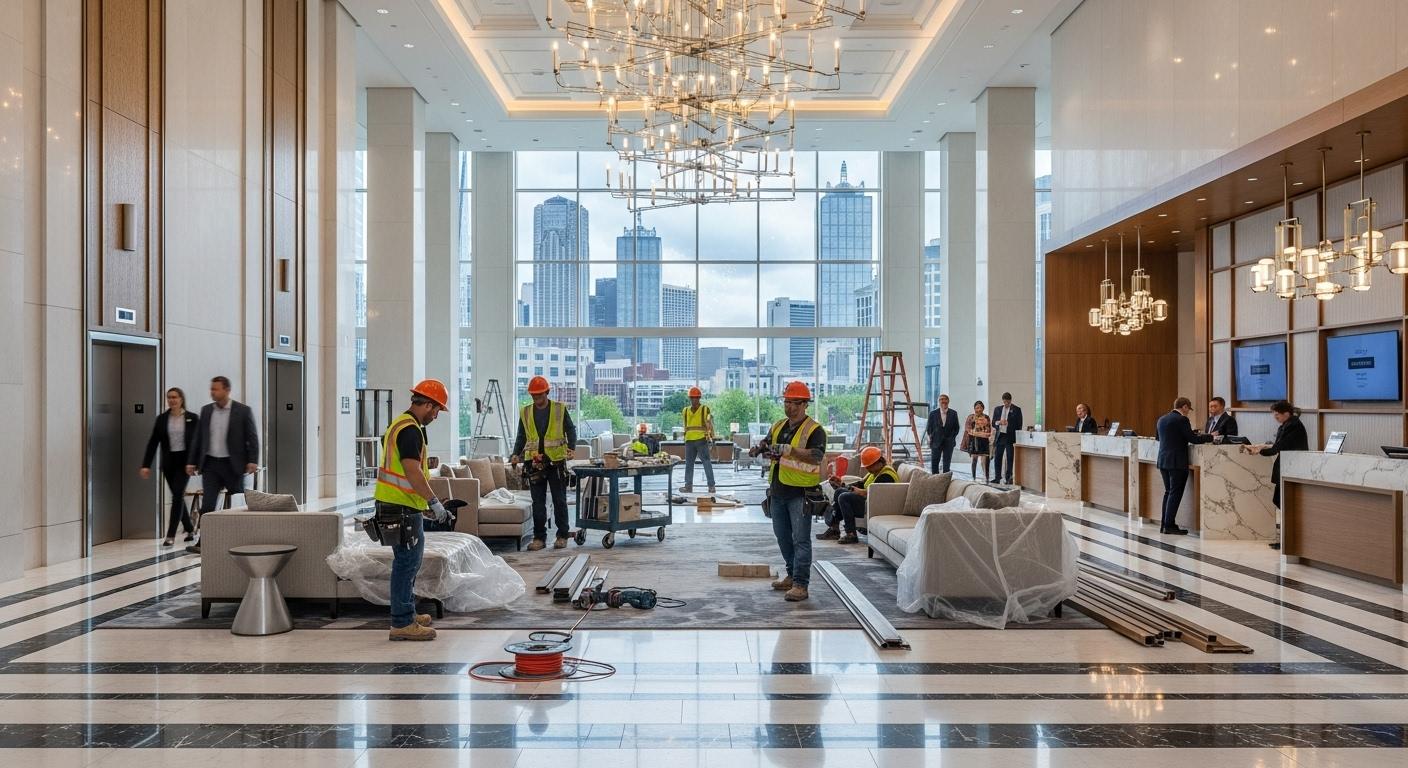
Common Area Revitalization: Lobby renovations, fitness center additions, and outdoor workspace creation mirror the amenities being implemented in successful projects like the 5600 Headquarters transformation in Plano.

Room Turn Strategies for Maximum Occupancy

Professional room turn services ensure minimal downtime between renovation phases, critical for maintaining cash flow during improvement projects. Fast, systematic room refreshes allow hotels to upgrade gradually while keeping most units available for booking.

Hotel renovations present unique challenges, requiring contractors experienced in maintaining operational continuity. Successful projects minimize guest disruption through careful scheduling, sound management, and dust control measures.

The key is working with construction partners who understand the hospitality industry’s 24/7 operational requirements. Experienced teams can coordinate renovation schedules around peak occupancy periods, ensuring guest satisfaction remains high throughout the improvement process.

Design-Build Advantages for Hotel Expansion

The design-build approach streamlines hotel expansion projects by integrating design and construction under single-source responsibility. This method reduces project timelines, controls costs, and minimizes coordination issues that often plague traditional design-bid-build projects.

For hotel owners considering expansion, design-build services offer several advantages:

  • Faster Project Delivery: Overlapping design and construction phases can reduce total project time by 20-40%
  • Cost Certainty: Single-source contracts provide better budget control and reduce change order disputes
  • Quality Integration: Design and construction teams collaborate from project inception, ensuring buildability and reducing conflicts

Third-Party Assessment Value for Hotel Investments

Before committing to major renovations or expansions, comprehensive Property Condition Assessments (PCA) and Capital Needs Assessments (CNA) provide crucial insights into existing infrastructure conditions and future maintenance requirements.

These assessments help hotel owners:

  • Prioritize improvement investments for maximum ROI
  • Identify potential structural or systems issues before they become expensive problems
  • Develop realistic budgets and timelines for renovation projects
  • Make informed decisions about property expansion feasibility

Veteran-Owned Construction Advantages

The National Defense Authorization Act (NDAA) 2025 increases opportunities for veteran-owned businesses, raising contracting goals from 3% to 5% for Department of Defense projects. While this primarily impacts government contracting, it reflects broader recognition of veteran-owned businesses’ reliability and discipline.

Veterans bring unique advantages to construction management, including:

  • Mission-focused approach with clear objectives and accountability
  • Proven teamwork and communication skills developed through military service
  • Attention to detail and quality standards essential for hospitality renovations
  • Problem-solving abilities crucial for managing complex occupied-environment projects

Companies like Alder Designs, a veteran-owned construction firm serving the Fort Worth and broader North Texas region, exemplify these qualities through their comprehensive approach to construction management and renovation services.

Maximizing Hotel Investment Returns

Strategic timing of hotel improvements can significantly impact ROI. With Plano’s major infrastructure investments creating improved accessibility and the mixed-use developments attracting new business and leisure traffic, hotel owners who modernize now position themselves to capture increased demand.

Key Investment Considerations

Market Positioning: Hotels that complete renovations before major developments like The Bend open in late 2025 will be best positioned to accommodate increased visitor traffic.

Operational Efficiency: Modern systems and energy-efficient improvements reduce ongoing operational costs, improving profit margins even before occupancy increases.

Guest Experience Enhancement: Updated amenities and modern design elements command premium rates and improve online review scores, driving direct bookings.

Planning Your Hotel Modernization Project

Successful hotel renovation requires careful planning and experienced execution. The process should begin with comprehensive assessment of current conditions, followed by strategic planning that balances guest experience improvements with operational efficiency gains.

Working with construction professionals who specialize in hospitality projects ensures understanding of industry-specific requirements, from noise control during overnight construction to maintaining security protocols during renovation work.

The combination of Plano’s robust economic growth, significant infrastructure investments, and increasing business travel demand creates an exceptional opportunity for hotel owners to maximize their property values through strategic modernization and expansion projects.

By partnering with experienced construction professionals who understand both the hospitality industry’s unique requirements and the local market dynamics, hotel owners can transform their properties into competitive assets that capitalize on North Texas’s continued growth and development.

0 Comments

Submit a Comment

Your email address will not be published. Required fields are marked *

Dallas–Fort Worth Construction Boom: Strategic Capital Improvements for Commercial Properties

As Dallas–Fort Worth’s construction pipeline accelerates, property owners must act to protect and grow asset value. This post outlines why PCAs and CNAs are the planning foundation, how phased renovations and room turns minimize disruption in occupied senior living, multifamily and commercial properties, and why design-build or CM-at-risk delivery plus third-party inspections drive better outcomes. Follow a clear five-step approach—commission a PCA, develop a CNA, secure financing, bid qualified contractors and execute with professional project management—to capture market opportunity, increase occupancy and avoid costly delays in 2026.

Plano’s $319M Infrastructure Investment: Opportunities for Senior Living Operators

Plano’s $319M Community Investment Program for FY25–26—targeting streets, drainage, erosion control, and safety—creates a prime moment for senior living operators in Plano and the broader DFW market. Improved access and reduced flood risk boost property values, occupancy potential, and resident satisfaction. Operators should prioritize HVAC, roofing, plumbing, exterior upgrades, and complete a Property Condition Assessment (PCA) or Capital Needs Assessment (CNA) to identify high‑ROI projects. Fast‑track renovations, design‑build delivery, and third‑party inspections enable safe, efficient work in occupied communities. Start with a professional assessment to capitalize on Plano’s infrastructure momentum and accelerate competitive, revenue‑driving improvements.

Hillwood Breaks Ground on Bonham-Baker Multifamily at Frisco Station

Hillwood has broken ground on Bonham-Baker, a new multifamily urban living community at Frisco Station that adds walkable housing, modern finishes, structured parking, and amenity-rich common areas near major employment centers. The development reinforces Frisco Station as a live-work-play hub and will drive ongoing needs for construction management, third-party inspections, and capital improvements across the area. Property managers and investors should plan for strategic oversight—assessment, bid reviews, and execution—to protect schedules, budgets, and long-term asset value. Read on to learn how expert construction services ensure a smooth build and strong returns.

Capital Improvements in Plano: Boost Rental & Senior Living Occupancy and Value

In Plano’s booming rental and senior-living market, strategic capital improvements—HVAC, roofing, kitchens/baths, plumbing/electrical, energy upgrades, and unit refreshes—drive higher rents, stronger occupancy, and increased property value. This article explains how Property Condition Assessments (PCAs/CNAs) guide ROI-based prioritization, and how phased, resident-sensitive construction keeps occupied communities operational and safe. Learn cost-control tactics, compliance tips, and how to choose experienced construction partners to deliver projects on time and on budget. Whether you’re an owner, operator, or investor, this guide shows which improvements pay off most in Plano’s competitive market.

Renovate Right in Denton: Smart Home Renovations During the Construction Boom

With Denton’s rapid pipeline of projects—from The Renegade apartments to Habitat Village and new retail developments—homeowners face unique renovation opportunities and risks. This guide explains how to vet contractors, plan capital and energy-efficient upgrades, and follow a four-step renovation process to keep projects on time and on budget. Learn the key questions to ask, red flags to avoid, and why certified or veteran-owned teams often deliver better results. Whether you’re updating a kitchen, replacing HVAC, or tackling a full remodel, this article helps Denton property owners make confident, value-driven decisions.

Central Texas Investors Prioritize Detailed PCAs and CNAs

Central Texas investors are increasingly demanding comprehensive property condition assessments (PCAs) and capital needs assessments (CNAs) before acquisitions or refinancing. Third‑party construction experts identify deferred maintenance, estimate capital expenditures, and audit contractor bids—helping buyers negotiate, secure financing, and plan strategic renovations. In Austin’s shifting market, detailed PCAs reduce risk, reveal energy‑efficiency and code compliance issues, and prioritize capital projects for multifamily, hospitality, and senior living assets. Learn why independent, veteran‑led construction advisory and thorough reporting are becoming prerequisites for smart investment decisions in Central Texas—and how a credible PCA can protect value and improve deal outcomes.

Leading McKinney, TX Renovation Company for Multifamily & Commercial Construction

A veteran-led renovation firm serving McKinney, TX, this article explains why property owners choose a disciplined, communication-focused partner for multifamily and commercial projects. From detailed assessments and design-build planning to full exterior rehabs, resident-amenity upgrades, and disaster rebuilds, the company emphasizes transparent budgets, realistic timelines, and quality workmanship. Ideal for landlords and property managers, their four-step process prevents surprises and maximizes asset value. Learn how this McKinney contractor delivers high-impact renovations on time and on budget.

Capital Improvements for Property Managers — Boost Occupancy & Asset Value | Alder Designs

Alder Designs, a veteran-owned construction partner in Fort Worth, helps property managers turn capital improvements into measurable returns. This post outlines data-driven strategies—property condition assessments, prioritized system replacements, room turns, tenant finishes, and energy-efficiency upgrades—that reduce emergency costs, speed lease-ups, and elevate asset value. Learn the four-step process from assessment and budgeting through execution and delivery, plus how to choose a contractor that minimizes disruption and protects your bottom line. Ready to improve occupancy and resident satisfaction? Start with a focused assessment and get a no-obligation quote from Alder Designs.

McKinney Construction Bids: 592 Local Projects Updated — 51,000+ Nationwide

ConstructConnect lists more than 51,000 active commercial projects nationwide, with 592 updated in the last 30 days within 75 miles of McKinney, TX. That pipeline spans residential subdivisions, senior living, offices, retail, fitness centers and municipal facilities — creating immediate bid opportunities for local contractors. This post explains where the demand is strongest, how to craft competitive bids (assessment, planning, execution), and why regional firms with design-build and construction-management expertise can capture market share. Learn how to target renovations, room turns and capital improvements to win work in North Texas.

Irving Senior Living Renovations: New Assisted‑Living Community Spurs Demand

Developers have announced a new assisted‑living and memory‑care community in Irving, driving demand for senior‑living renovations across northwest Dallas County. Operators planning capital improvements must address HVAC and roofing upgrades, life‑safety systems, accessibility, and high‑amenity interiors while keeping residents safe and operations uninterrupted. Professional CNAs and PCAs guide budgeting and financing, while fast, coordinated room turns preserve occupancy. Experienced contractors who understand occupied‑care sequencing, bid reviews, and design‑build approaches are in demand. This article outlines key renovation priorities, compliance considerations, and how to select construction partners that deliver quality, minimize disruption, and protect residents during complex senior‑living projects.