
I need to retrieve the specific details from the previous workflow steps to create your blog post. Let me gather that information now.
Capital Improvements and Unit Turns: How DFW Property Managers Drive Value-Add Returns
The Dallas–Fort Worth multifamily market is booming, and property managers who execute strategic capital improvements are pulling ahead of the competition. With strong renter demand, continued transaction activity, and new supply coming online, owners and operators in Fort Worth, Dallas, and surrounding suburbs are leveraging disciplined renovation programs to keep assets competitive and maximize returns.
Whether you’re managing apartment communities, senior housing, or mixed-use properties, the path to sustainable value-add is clear: capital improvements and unit turns are no longer optional—they’re essential to staying competitive in today’s market.
Why Capital Improvements Matter in the DFW Market
The Dallas–Fort Worth corridor continues to attract investors seeking value-add opportunities. Unlike ground-up development, which requires longer timelines and higher risk, capital improvement plays deliver faster returns and allow operators to reposition aging or underperforming assets without starting from scratch.
Capital improvements—roofing upgrades, HVAC replacements, exterior rehabs, and unit interior refreshes—directly impact three critical business metrics: resident satisfaction, occupancy rates, and asset valuation. When potential residents walk into a newly renovated unit with modern finishes, energy-efficient systems, and contemporary amenities, you’re not just filling a lease—you’re justifying higher rents.
In Fort Worth and across the DFW metro area, multifamily operators are seeing 8–12% rent growth on newly renovated units. Senior living communities and hospitality properties have discovered that strategic unit turns reduce vacancy periods and increase operational efficiency while occupied-property renovations minimize disruption to existing residents.
The Unit Turn Strategy: Speed and Precision
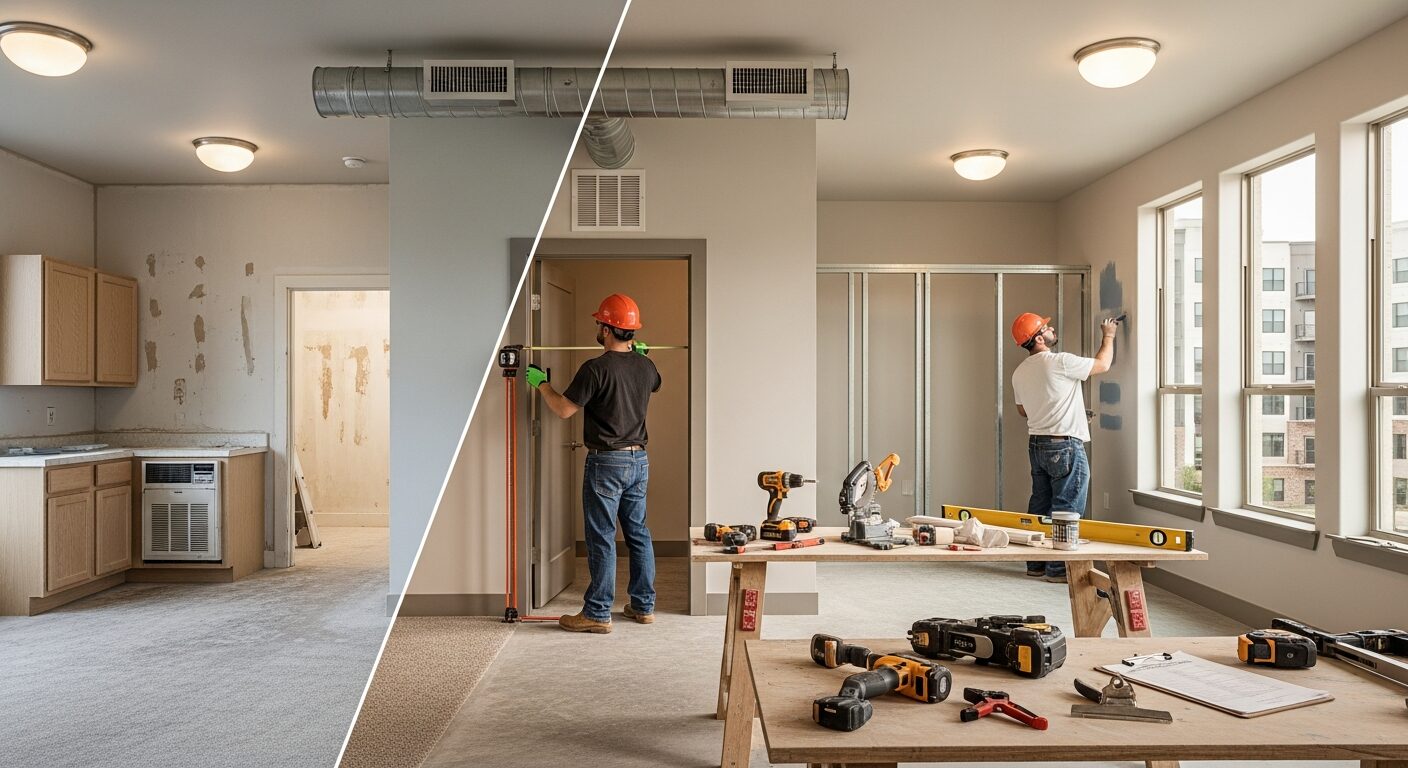
A unit turn—the rapid refresh and repositioning of an apartment between tenants—is one of the fastest ways to increase revenue. Fast, professional room turns maximize occupancy and reduce the costly downtime that eats into profitability.
Here’s the challenge: standard contractors often lack the discipline, coordination, and speed required to complete quality unit turns on schedule. Delays ripple across your entire property, vacancies extend, and revenue targets slip.
Specialized unit turn contractors understand the pressure. They arrive with proven checklists, dedicated teams, and the ability to work in phases around your occupancy schedule. They coordinate inspections, flooring, painting, fixture upgrades, and final cleanings with military precision—literally, if you partner with a veteran-owned firm that applies construction discipline to every project.
In McKinney, Allen, Frisco, and throughout the DFW metroplex, property managers partnering with experienced unit turn specialists report 15–20% faster turnarounds compared to traditional construction crews.
Strategic Renovation Planning: From Assessment to Execution
Successful capital improvement programs begin with a clear assessment of where your investment delivers the greatest return.
A property condition assessment (PCA) or capital needs assessment (CNA) identifies building system priorities—which components are reaching end-of-life, which upgrades would most appeal to renters, and where hidden maintenance costs lurk. This data-driven approach eliminates guesswork and ensures your renovation budget targets high-impact improvements first.
The best renovation contractors offer a four-step process:
- Assessment – Evaluate the property’s current condition and identify improvement opportunities aligned with market demand and resident expectations.
- Planning – Develop a phased renovation strategy that minimizes operational disruption, aligns with your budget, and prioritizes high-impact upgrades.
- Execution – Deliver renovations on time, within budget, and in occupied environments without compromising resident experience.
- Delivery – Verify completion quality, manage inspections, and ensure smooth transitions for residents and new leasing activity.
This process works equally well for roofing upgrades, HVAC replacements, exterior rehabs, and interior unit turns. In the DFW market, phased renovation approaches allow property managers to spread costs over time while maintaining steady occupancy and revenue flow.
Specialized Expertise: Senior Living, Hospitality, and Commercial Spaces
Different property types require different renovation expertise.
Senior living facilities demand additional focus on accessibility, safety systems, and quality finishes that appeal to both residents and their families. Life-safety improvements, grab bars, wider doorways, and modern healthcare-compatible systems are non-negotiable. Contractors experienced in senior housing understand regulatory requirements and the need for minimal disruption to active communities.
Hospitality properties—hotels, resorts, and extended-stay facilities—require rapid turnarounds between guests and careful coordination to maintain day-of-service excellence. A single room renovation might take 12–24 hours; a full-property brand conversion demands sophisticated project management and phased execution across hundreds of rooms.
Commercial spaces and tenant finishes require precision to accommodate diverse tenant needs. Office rebuilds, retail buildouts, and mixed-use improvements demand contractors who can manage complex scopes, multiple stakeholders, and tight timelines.
In Fort Worth, Dallas, and across the DFW region, property managers working with contractors who specialize in these sectors report higher resident satisfaction, faster lease-ups, and stronger brand positioning.
Managing Renovations in Occupied Properties
One of the most challenging aspects of renovation strategy is managing construction in occupied environments. Unlike vacant buildings, you can’t simply close the doors and begin work—residents are living there, daily operations continue, and any disruption directly impacts satisfaction and retention.
Experienced contractors bring strategies for occupied-property success:
- Scheduling coordination – Plan work around resident quiet hours, community events, and lease expirations to minimize disruption.
- Clear communication – Keep residents informed about project timelines, access restrictions, and expected noise.
- Safety and security – Maintain controlled access, secure building zones, and protect resident privacy throughout construction.
- Quality assurance – Deliver finished work without compromising occupancy or safety standards.
Multifamily operators in McKinney, Allen, Frisco, and throughout the Fort Worth area have found that contractors with dedicated experience in occupied renovations complete projects faster, with fewer resident complaints, and with better outcomes.
The ROI of Professional Construction Management
Cutting corners on construction management is tempting—but it often costs more in the long run. Poor project oversight leads to delays, budget overruns, rework, and extended vacancy periods. On a 200-unit property, a single week of delay across a unit turn program can cost $8,000–$12,000 in lost rent.
Professional construction management—including pre-construction planning, phased execution, independent inspections, and contractor audits—ensures quality, controls costs, and accelerates lease-ups.
Many DFW property owners and managers work with independent contractors for bid reviews and payment audits, particularly on large capital improvement programs. This oversight ensures competitive pricing, prevents overpayment, and validates that work completed meets contracted specifications.
Choosing a Construction Partner for DFW Properties
When selecting a renovation contractor or construction management partner, look for firms with:
- Proven experience in your property type (multifamily, senior living, hospitality, commercial) and market (Fort Worth, Dallas, DFW suburbs).
- Transparent communication and clear project timelines with realistic delivery dates.
- Specialized certifications and industry recognition, particularly in capital improvements or design-build services.
- Occupied-property expertise if your communities are fully or partially occupied during renovations.
- Fast turnaround capabilities for unit turn programs that need to move quickly between tenants.
- Budget accountability with clear cost estimates, no surprise charges, and commitment to on-time, on-budget delivery.
- Local knowledge of Fort Worth and DFW market trends, supplier relationships, and seasonal considerations.
The veteran-owned construction firms operating across the DFW region understand that property managers juggle dozens of competing priorities. They arrive with military discipline applied to construction timelines and the integrity required to manage your most valuable assets.
Capital Improvements as a Path to Competitive Advantage
The DFW multifamily market moves fast. Properties that execute strategic capital improvements while maintaining smooth operations gain occupancy advantages, justify higher rents, and attract investors seeking stabilized, value-add opportunities.
Whether you’re planning a single-property unit turn program, a comprehensive roof or HVAC upgrade, or a full repositioning strategy, the most successful property managers partner with contractors who combine construction expertise with operational awareness. These partnerships deliver faster timelines, better quality, transparent costs, and the peace of mind that comes from working with teams committed to your success.
In Fort Worth, Dallas, and across the DFW metroplex, the competition for quality residents and strong returns is real. Strategic capital improvements and professional construction management aren’t just nice-to-have amenities—they’re the foundation of sustainable, competitive multifamily operations.
0 Comments