
I need to retrieve the specific details from the previous workflow steps to write the blog post. Let me gather the information now.
Senior Living Renovations in Fort Worth: Maximize Occupancy While Maintaining Operations
Senior living facilities face a unique challenge: upgrading spaces to attract and retain residents without disrupting daily operations or overwhelming the existing population. When you manage a senior living community, a slow renovation creates anxiety and inconvenience for residents, while a poorly planned project can damage your reputation and bottom line. The solution is strategic construction services that balance speed, quality, and operational continuity—exactly what modern senior living operators need in Fort Worth, Texas.
Why Senior Living Communities Need Professional Room Turns and Renovations
Senior living facilities typically experience turnover rates between 20% and 30% annually. Every vacant unit represents lost revenue and increased pressure to fill beds quickly. When a resident moves out, you have a narrow window—often just days—to refresh that space, update finishes, and prepare it for new residents. This urgency demands more than a standard contractor; it requires a team that understands the unique constraints of occupied senior living environments.
Fast room turns directly impact your bottom line. A unit that sits empty for two weeks costs you approximately $800 to $2,000 in lost monthly rent, depending on your community’s pricing. Multiply that across multiple turnovers per year, and renovation speed becomes a critical financial metric. Property managers and executive directors prioritize contractors who can execute quality refreshes on accelerated timelines without cutting corners or leaving punch list items that frustrate new residents.
Beyond occupancy speed, senior living residents and their families expect clean, updated, safe spaces. Modern families researching senior communities heavily weight unit condition and recent renovations in their decision-making process. A well-executed room turn—featuring updated appliances, fresh finishes, and accessibility improvements—directly influences your marketing advantage and fill rates.
Capital Improvements That Strengthen Your Competitive Position
Senior living communities compete fiercely for market share. Strategic capital improvements—whether roofing replacements, HVAC upgrades, plumbing modernization, or energy-efficient retrofits—send a powerful message to prospective residents and families: this community invests in quality and longevity.
Energy upgrades deserve special attention in today’s market. Rising utility costs directly erode your operating margins. Upgrading to efficient HVAC systems, LED lighting, or smart thermostats reduces monthly expenses and demonstrates fiscal responsibility to residents and family members concerned about fee increases. These improvements also align with growing elder care standards and regulatory expectations around facility maintenance.
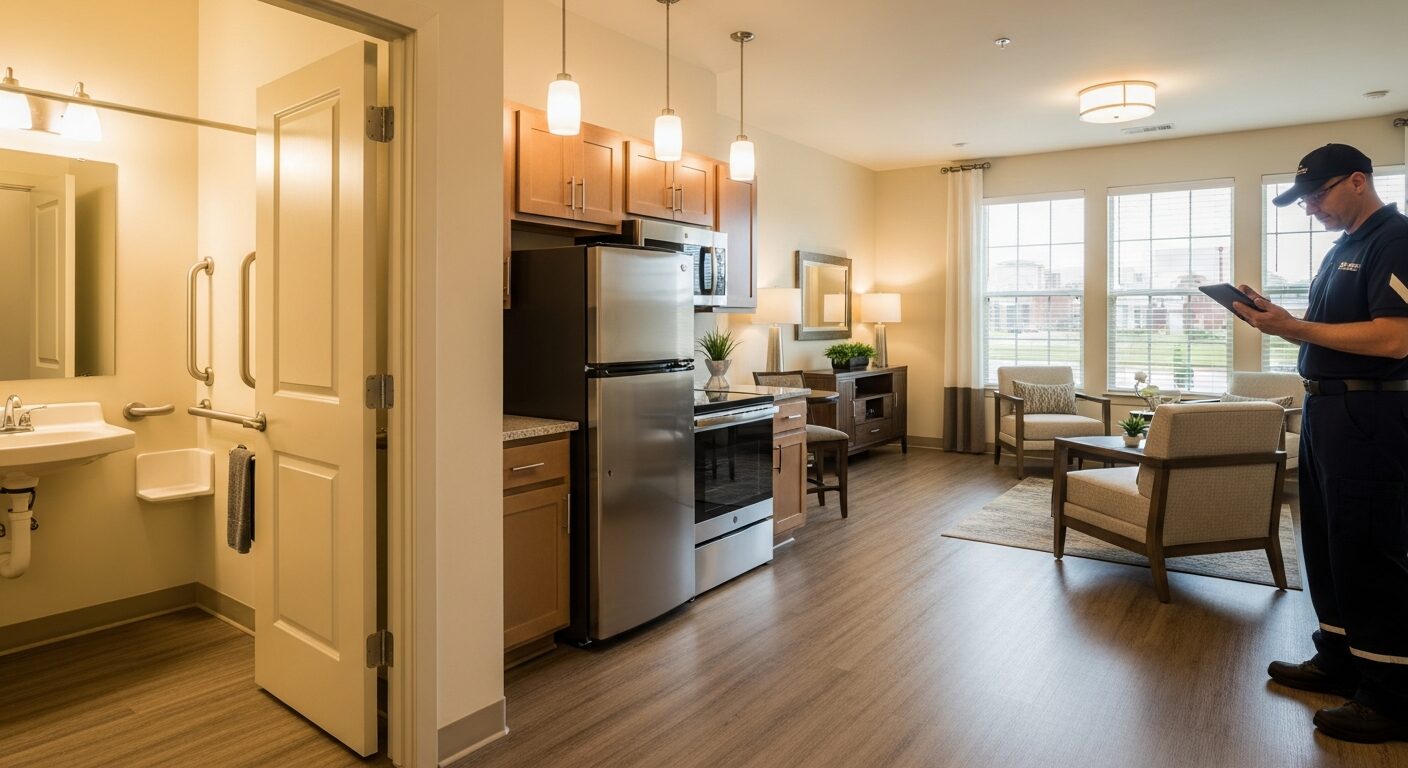
Accessibility and safety improvements are non-negotiable. ADA compliance, grab bar installations, lighting enhancements, and flooring upgrades improve resident safety while reducing liability and insurance concerns. When you combine these mandated improvements with aesthetic updates—new paint, updated fixtures, modern finishes—you create spaces that feel intentionally renovated rather than clinically upgraded.
Investors and operators increasingly request third-party property condition assessments (PCA) and capital needs assessments (CNA) before acquiring senior living communities or justifying major capital requests to boards and lenders. These independent reports identify hidden issues, prioritize spending, and provide defensible documentation for renovation budgets.
The Complexity of Construction in Occupied Senior Living Environments
Here’s the reality many contractors don’t understand: construction in occupied senior living communities is fundamentally different from residential renovations or commercial builds. Residents are sensitive to noise, disruption, and change. Staff must continue daily operations—meals, medication, care activities—while contractors work nearby. Infection control protocols may restrict access to certain areas. Noise during early mornings or late evenings is disruptive to sleep-sensitive older adults.
A contractor unfamiliar with senior living operations will create friction, generate resident complaints, and ultimately damage your community’s reputation. The right construction partner integrates seamlessly into your operational rhythm. They schedule work around meal times, limit noise during rest periods, maintain cleanliness standards, and communicate transparently with residents and families about timelines and inconveniences.
Additionally, senior living facilities often require concurrent operations during renovations. You can’t simply close a wing for three months; you need a construction team that can manage phased rollouts, sequence work to minimize occupant disruption, and maintain building systems (fire suppression, emergency lighting, HVAC) throughout the project.
What to Look for in a Senior Living Construction Partner
When evaluating contractors for your senior living facility, focus on three critical dimensions: experience, transparency, and reliability.
Experience means more than general construction knowledge. Look for contractors with documented success in senior living facilities, understanding of regulatory compliance, and a proven process for occupied renovations. Ask for references from other senior living communities and request to tour completed projects. A contractor with 70+ years of combined construction expertise and a track record in hospitality and senior living brings institutional knowledge that protects your timeline and budget.
Transparency encompasses clear communication, honest bidding, and realistic timelines. A reputable contractor provides detailed quotes, explains the four-step process (assessment, planning, execution, delivery), and maintains open communication throughout the project. They’re upfront about potential challenges—hidden structural issues, permit delays, material constraints—rather than discovering them mid-project and requesting change orders.
Reliability means on-time delivery and budget adherence. Senior living facility directors live with renovation stress until the project concludes. Delays cascade: postponed occupancy, staff frustration, resident anxiety, marketing pressure. A dependable contractor commits to timelines and delivers without excuses. Military discipline and proven project management processes—like those brought by veteran-owned construction firms—often correlate with stronger reliability.
Strategic Assessment: The Foundation of Successful Renovations
Before any demolition or painting begins, a comprehensive assessment prevents costly surprises. Professional assessments identify structural concerns, mechanical system condition, code compliance gaps, and accessibility deficiencies that might otherwise emerge mid-project.
For senior living communities specifically, assessments should address:
- Structural integrity and foundation condition
- HVAC system capacity and efficiency (critical for senior health)
- Plumbing and water quality (impact on resident health)
- Electrical system adequacy for modern technology and safety upgrades
- Roof condition and remaining useful life
- ADA compliance and accessibility gaps
- Infection control and cleanliness standards
- Safety systems (fire suppression, emergency lighting, evacuation routes)
A professional assessment costs $2,000 to $10,000 depending on facility size—but it saves tens of thousands in prevented change orders and project delays. For property managers and executive directors making capital planning decisions, assessments provide the evidence needed to justify spending and set realistic budgets with boards and lenders.
Navigating Fort Worth Permitting for Senior Living Renovations
Senior living facility renovations in Fort Worth, Texas require navigating local building codes, permit requirements, and inspection schedules. Fort Worth’s Development Services Department oversees residential and commercial permits, and the process has become increasingly digital. Understanding permit requirements upfront prevents delays that directly impact your occupancy timeline.
Fort Worth requires permits for:
- Structural changes
- HVAC replacements or modifications
- Plumbing and electrical work
- Roofing replacements
- Building system upgrades
- Accessibility modifications
Working with a contractor familiar with Fort Worth permitting accelerates approvals. They understand zoning overlays, plan review expectations, and inspection milestones. They schedule inspections at optimal intervals, prepare documentation correctly on first submission, and maintain relationships with Development Services staff—all reducing approval timeframes.
Unpermitted work carries penalties ranging from fines to forced removal of work, plus liability issues for your facility. A professional contractor ensures full compliance, protecting your community’s reputation and reducing insurance risk.
The Financial Impact: ROI of Quality Renovations in Senior Living
Senior living communities operate on thin margins. Every capital dollar must demonstrate clear return on investment. Here’s how strategic renovations drive financial outcomes:
Faster occupancy from quality room turns: A professionally executed room turn reduces vacancy time from 14-21 days to 7-10 days. Over a year, even a 20-unit community benefits from 4-8 additional occupied months, recovering $3,200-$16,000 in revenue depending on unit price.
Improved fill rates and admission rates: Newer units with updated finishes directly influence family decision-making. Marketing teams report stronger lead-to-admission conversion when units appear freshly renovated. A 2-3% improvement in fill rates translates to $6,000-$9,000 in annual revenue for a 30-unit community.
Reduced operational costs from efficiency upgrades: Energy-efficient HVAC and lighting can reduce monthly utility costs by 15-25%. A senior living community spending $3,000 monthly on utilities saves $450-$750 per month ($5,400-$9,000 annually) from upgrades that cost $12,000-$25,000—recovering investment in 2-3 years.
Protected asset value: Well-maintained facilities with documented capital improvements command higher valuations during refinancing or sale. A community that systematically upgrades demonstrates stewardship to potential buyers and lenders, potentially increasing valuation by 5-10% on a $5-10 million asset.
Enhanced reputation and resident satisfaction: Newer spaces reduce resident complaints, improve family satisfaction, and generate positive word-of-mouth marketing. Satisfied residents stay longer (reducing turnover), pay renewal fees without resistance, and recommend your facility to peers—directly supporting occupancy stability.
Selecting a Veteran-Owned Construction Partner for Integrity and Accountability
Veteran-owned construction firms bring distinct advantages to senior living renovations. Military discipline translates directly to project execution excellence. Veterans understand hierarchical communication, chain of command clarity, and accountability—attributes that reduce scope creep, prevent miscommunication, and ensure quality standards are maintained throughout projects.
Additionally, veteran-owned firms operating in Fort Worth and serving senior living communities often bring mission-driven values aligned with senior care itself. These teams understand dedication to quality, respect for occupants, and commitment to leaving things better than you found them. They approach senior living renovations with the same precision and care they applied to military projects—no shortcuts, no excuses.
A veteran-owned construction company with proven track record in senior living facilities brings 70+ years of combined expertise, making them a trustworthy partner for complex, occupied environment renovations. Ask about their process: How do they manage resident communication? What quality standards do they maintain? How do they handle unexpected issues? The answers reveal whether they’ve truly worked in senior living or are simply general contractors unfamiliar with your unique needs.
Planning Your Senior Living Renovation: A Roadmap
Phase 1: Assessment. Hire a professional assessment team to evaluate your facility’s condition, identify capital priorities, and project realistic budgets. This typically takes 2-4 weeks and costs $3,000-$10,000 depending on facility size.
Phase 2: Planning. Work with your construction partner to develop a phased approach that minimizes disruption. Determine which units or areas get renovated first, establish realistic timelines, and establish clear communication protocols with residents and families.
Phase 3: Execution. Begin the renovation with transparent, regular communication. Schedule work around resident activities, maintain cleanliness standards, and address resident concerns immediately. A professional partner maintains visibility on progress and prevents surprises.
Phase 4: Delivery. Complete punch list items promptly, conduct final inspections, and ensure systems are tested and operational. A quality renovation extends beyond completion day—it means sustained performance and resident satisfaction months later.
Why Timing Matters: Spring Renovations in North Texas
March through May represents ideal timing for senior living renovations in the Fort Worth area. Spring weather supports construction work: mild temperatures, lower humidity, and reduced HVAC strain. Contractor availability tends to be better in spring than summer, meaning faster scheduling and potentially better pricing. Completing renovations by early summer positions your facility to maximize occupancy during summer and fall—peak admission seasons for many senior living communities.
Spring planning also allows you to showcase renovated units at your community’s open houses and family events, capitalizing on seasonal activity increases. Starting planning now positions your facility to complete major projects by June or July, maximizing the competitive advantage.
Moving Forward: Your Next Steps
Senior living facility renovations require a construction partner who understands your industry, respects your residents, and executes with precision. Start by requesting a professional property condition assessment if you haven’t already completed one. This assessment becomes the foundation for all subsequent renovation decisions, budgeting, and planning.
Next, interview construction contractors with demonstrated senior living experience. Ask specific questions about occupied environment management, their process for resident communication, and how they’ve handled unexpected issues in previous senior living projects. Request references from other senior living communities and verify their track record with independent assessments.
Finally, work with your selected partner to develop a phased renovation plan that balances capital improvement priorities with operational continuity. Clear timelines, transparent communication, and realistic expectations set the stage for a successful project that strengthens your community’s competitive position and improves resident satisfaction without operational disruption.
Senior living communities deserve construction partners who understand that renovating spaces where vulnerable populations live requires more than technical skills—it requires respect, discipline, and unwavering commitment to quality. The right contractor becomes an extension of your team, not an external vendor imposing disruption on your operations.
0 Comments