
I need to retrieve the previous step outputs to access the business details, article information, and internet search data. Let me gather that information now.
Capital Improvements and Strategic Renovations for Denton’s Growing Multifamily Market
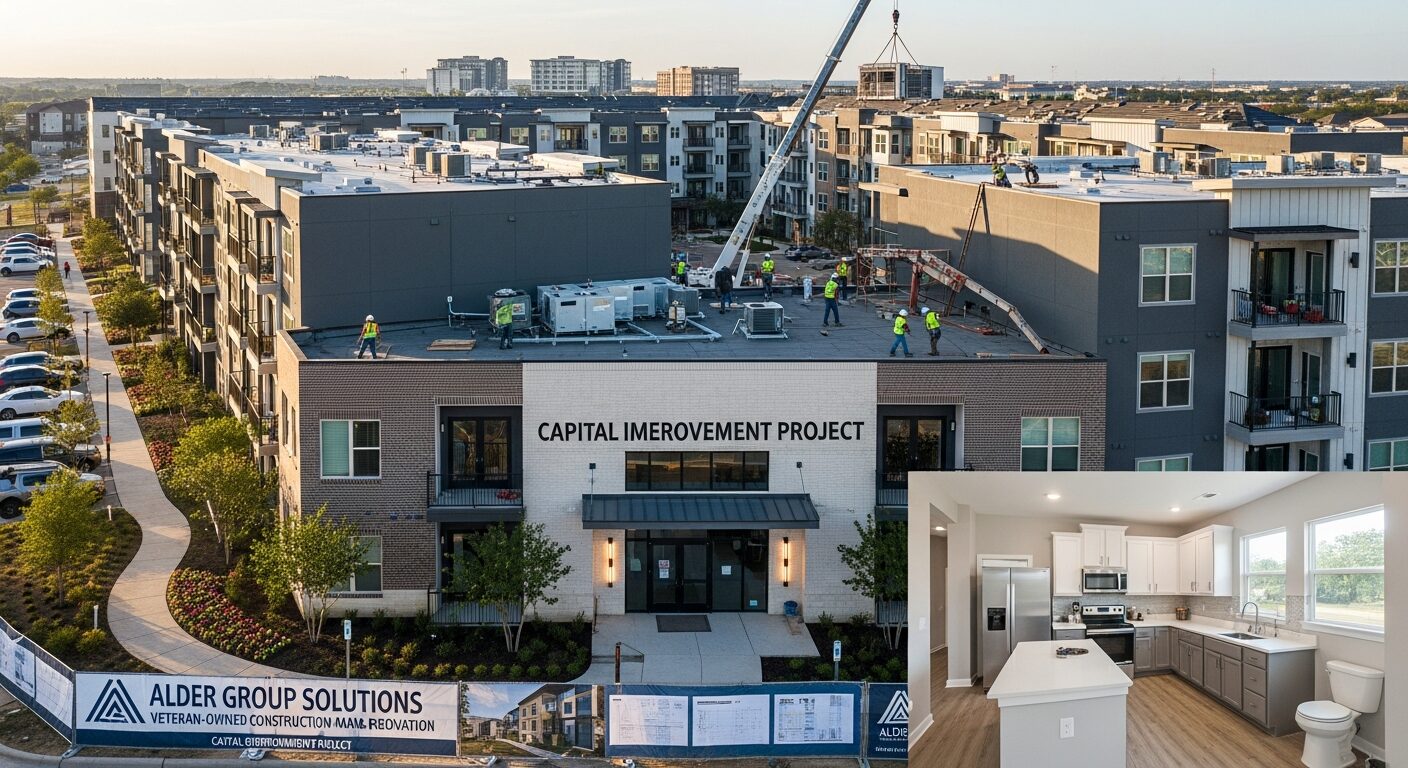
Denton, Texas is in the middle of a construction boom that’s reshaping the city’s real estate landscape. With over $1 billion in multifamily projects under way or in planning stages, property owners and managers face mounting pressure to keep their existing portfolios competitive while maintaining operational continuity. Capital improvements and strategic renovations aren’t just upgrades anymore—they’re essential investments that directly impact occupancy rates, tenant retention, and property valuations in a rapidly evolving market.
The challenge is clear: how do you execute complex renovations, unit turns, and capital assessments without disrupting daily operations? This is where strategic construction management and expert renovation services become critical differentiators.
Why Denton’s Multifamily Boom Creates Urgent Capital Improvement Needs
Denton’s multifamily market is accelerating faster than most property managers anticipated. Recent projects illustrate the scale: JPI is breaking ground on a 415-unit development, while another $132 million workforce housing community is launching nearby. Additionally, 297 units of new affordable housing and The Renegade—a 104-unit Class A downtown development—are transforming the competitive landscape.
This influx of newer, modernized properties creates a direct challenge for existing property owners: buildings completed just five to ten years ago are now competing against brand-new communities with contemporary finishes, energy-efficient systems, and enhanced amenities. Simply maintaining the status quo isn’t enough anymore.
Property investors and managers in Denton are discovering that strategic capital improvements directly protect their market position. Units that undergo professional renovations and room turns command higher rents. Properties with upgraded HVAC, roofing, and energy systems reduce operating expenses and attract environmentally conscious tenants. And properties backed by certified third-party property condition assessments and capital needs assessments (CNA) command stronger valuations during refinancing or sale.
Understanding Capital Improvements vs. Basic Maintenance
Not all renovation work is created equal, and property managers need to understand the difference between reactive maintenance and strategic capital improvements.
Basic maintenance addresses immediate problems—a leaking faucet, a failing unit HVAC system, or roof repairs. While necessary, these are cost-centers that don’t typically add value to the property.
Capital improvements, by contrast, are intentional upgrades that extend asset life, increase functionality, or enhance desirability. Examples include:
- Full unit renovations with modern appliances, updated flooring, and refreshed bathrooms
- Building-wide HVAC and plumbing upgrades that reduce energy consumption and service calls
- Roofing and structural improvements that extend the life of the building
- Common area enhancements including lobbies, fitness centers, and landscaping
- Energy-efficient systems and controls that lower utility costs
The distinction matters financially. Capital improvements are often depreciable assets that can be claimed on tax returns, and they justify higher lease rates and attract quality tenants who value modern, well-maintained spaces.
In Denton’s competitive multifamily environment, the properties winning the occupancy game are those making strategic capital investments. And that requires partnering with contractors and construction managers who understand both the technical execution and the business impact.
The Strategic Property Condition Assessment: Your Roadmap for Smart Investments
Before committing significant capital to improvements, property managers need a clear understanding of their building’s actual condition and the urgency of needed work. This is where certified property condition assessments (PCA) and capital needs assessments become invaluable.
A professional PCA evaluates all major building systems—structural integrity, roofing condition, HVAC functionality, plumbing, electrical systems, and more. The assessment produces a ranked prioritization of work, with costs and timelines, so property managers can strategically allocate capital rather than reacting to crises.
A capital needs assessment goes a step further, projecting 30-year capital expenditure plans that help owners and investors understand the true cost of ownership and plan for necessary replacements before systems fail.
In a market like Denton where property competition is intensifying, a PCA or CNA isn’t a luxury—it’s the foundation of smart investment decisions. Properties that understand their condition can:
- Justify renovation budgets to investors and lenders with data-backed recommendations
- Avoid costly emergency repairs by addressing wear and tear proactively
- Enhance refinancing appeal with documented building condition and upgrade plans
- Set realistic rent growth based on the property’s competitive position and upgrade timeline
Experienced construction management firms in Fort Worth and Denton can conduct these assessments and then execute the recommended work seamlessly, keeping the project on budget and the property operational throughout.
Fast, Professional Room Turns: Minimizing Vacancy and Maximizing Occupancy
In multifamily properties, every day a unit sits vacant is lost revenue. Denton’s competitive market has tightened turnover timelines—property managers are expected to refresh units and get them leased faster than ever.
A professional room turn is a coordinated effort to:
- Clean and refresh carpet, paint, and flooring
- Upgrade appliances and fixtures if budget allows
- Repair damage and address wear
- Enhance curb appeal
- Complete all work within a compressed timeline
High-impact room turns don’t mean cutting corners—they mean executing efficiently with experienced crews who understand the sequence of work and manage scheduling to minimize delays.
In busy markets like Denton, professional room turn services directly impact the bottom line. A property that turns units in 5–7 days instead of 10–14 days significantly reduces vacancy loss. And units that undergo high-quality renovations lease faster and at higher rents, which compounds the ROI over time.
The challenge many property managers face is finding contractors who can deliver speed without sacrificing quality. This requires:
- Dedicated, experienced crews trained in efficient turnover procedures
- Project coordination that sequences work logically and minimizes rework
- Quality control that catches issues before units are offered to prospective tenants
- Transparent timelines so property managers know exactly when units will be ready
Construction Management in Occupied Environments: The Hidden Challenge
One of the most complex construction scenarios is executing renovations and capital improvements in occupied buildings. Unlike ground-up construction, you’re managing crews, material delivery, noise, and disruption while residents are living in the property.
This is where military-grade discipline and meticulous planning make all the difference. Construction teams working in occupied senior living communities, hospitality properties, or multifamily buildings need to:
- Coordinate around resident schedules to minimize disruption
- Manage noise and dust to maintain livability and resident satisfaction
- Secure work areas to maintain safety and privacy
- Communicate transparently with property management and residents
- Adapt schedules when unexpected issues arise without blame-shifting
Denton’s rapid growth means many property owners are choosing renovation and repositioning over ground-up development. This creates consistent demand for contractors with proven expertise in occupied-environment construction and the discipline to execute complex work without compromising resident experience.
Design-Build Services: Simplifying Complex Renovation Projects
When a property owner or manager envisions a major renovation—a significant unit refresh, a common area redesign, or a structural upgrade—the traditional design-bid-build process can be slow and cumbersome. You engage an architect, develop plans, release bids to multiple contractors, manage conflicts between design and construction, and navigate cost overruns.
Design-build services compress this timeline and simplify the process. A single team handles both design and construction, which means:
- Faster permitting and approvals because the design accounts for constructability
- Better cost control because the builder is involved from the design phase
- Reduced surprises during construction because potential conflicts are resolved upfront
- Clearer accountability since one team is responsible for design, permits, and execution
In Denton, where the market is moving quickly and property owners often need to reposition assets to stay competitive, design-build services offer a practical advantage. Whether it’s a hospitality tenant finish, a senior living renovation, or a multifamily unit refresh program, design-build keeps projects on track and on budget.
Why Bid Reviews and Contractor Audits Matter for Property Investors
Property investors and managers are frequently approached by contractors pitching renovation work. But not all contractors deliver equal value, and bidding processes can hide inflated costs, low-quality workmanship, or unrealistic timelines.
A bid review by an experienced construction professional evaluates contractor proposals against:
- Market-rate pricing for similar work
- Project scope clarity to identify missing or vague deliverables
- Timeline realism based on complexity and crew size
- Contractor track record and financial stability
- Quality standards embedded in specifications
A contractor audit goes further, evaluating the work itself to ensure the contractor is delivering per the agreement and to identify any quality issues before final payment.
For property investors managing large portfolios across Denton and the Fort Worth area, bid reviews and contractor audits are essential risk management tools. They protect against overpriced work, scope creep, and poor quality that could damage the asset and investor returns.
Addressing Denton’s Senior Living and Hospitality Renovation Demand
Beyond multifamily, Denton is seeing significant growth in senior living communities and hospitality properties, both of which require specialized renovation expertise.
Senior living communities are investing heavily in modernization to attract residents and support aging-in-place living. This includes:
- Updated interiors and flooring for accessibility and aesthetics
- Enhanced building systems for reliability and efficiency
- Common area improvements to support social and wellness programming
- Accessibility upgrades throughout the community
Hospitality properties—hotels, resorts, and vacation rentals—require regular capital improvements to maintain competitiveness and guest satisfaction. These include:
- Guest room refreshes with modern furnishings and technology
- Building system upgrades for reliability
- Common area enhancements like lobbies, restaurants, and conference spaces
- Exterior and grounds improvements
Both property types face the challenge of executing renovations in occupied environments while maintaining operations and guest experience. Contractors with experience in these specialized segments understand the unique constraints, timelines, and quality standards required.
The Role of Transparency and Clear Communication in Renovation Success
Property owners and managers often have negative renovation experiences because of miscommunication, hidden costs, or timeline slippage. This erodes trust and makes future project planning stressful.
Forward-thinking construction firms understand that transparency isn’t just ethical—it’s good business. This means:
- Clear, written project plans that detail scope, timeline, and budget
- Regular communication about progress, any discovered issues, and next steps
- Upfront identification of contingencies and potential cost variables
- Honest assessment of what’s possible and realistic within budget and timeline
- Documented decisions so changes are tracked and approved before work is modified
In Denton’s competitive market, property managers are learning to partner with contractors who communicate like this. It reduces stress, keeps projects on track, and builds lasting relationships that simplify future work.
Capital Improvements as a Strategic Competitive Advantage
Denton’s multifamily boom is reshaping market expectations. Properties that don’t invest in strategic renovations and capital improvements will increasingly struggle to attract and retain quality tenants. Conversely, properties that stay ahead of the curve with thoughtfully planned capital investments will command premium rents, maintain higher occupancy, and maintain stronger valuations.
The path forward requires:
- Understanding your property’s condition through professional assessments
- Prioritizing work strategically based on ROI and competitive necessity
- Partnering with experienced contractors who deliver quality in occupied environments
- Maintaining transparent communication throughout renovation work
- Planning for the long term with realistic capital needs projections
For property owners and managers in Fort Worth and Denton, veteran-owned construction firms with deep expertise in renovation, room turns, design-build services, and occupied-environment work are invaluable partners. These firms combine military discipline, extensive experience, and transparent communication to execute capital improvements that protect asset value and support long-term success in an increasingly competitive market.
The time to act is now. In Denton’s accelerating multifamily market, strategic capital improvements aren’t a nice-to-have investment—they’re the foundation of competitive success.
0 Comments