
Why Hospitality Construction Needs Design-Build Expertise in Fort Worth and Austin
The hospitality industry is booming across Texas. From luxury hotel expansions to cutting-edge destination resorts, property owners are investing heavily in creating exceptional guest experiences. But hospitality construction demands more than standard building practices—it requires specialized expertise, seamless coordination with active operations, and a partner who understands both the complexity of occupied environments and the tight timelines that drive profitability.
Whether you’re managing a Hyatt Place renovation in Fort Worth’s Historic Stockyards or planning the next generation of destination hospitality in Austin, having the right construction partner makes all the difference between a project that delivers on time and budget versus one that disrupts operations and drains resources.
The Hospitality Construction Boom in Texas
Texas is experiencing unprecedented growth in hospitality development. Recent projects across the region illustrate the scope and scale of this demand.
Fort Worth’s Hyatt Place at the Historic Stockyards is in active renovation, upgrading guest rooms, public spaces, and surrounding infrastructure to capture rising tourism and business travel. Meanwhile, Austin’s hospitality landscape is evolving with one of the state’s most ambitious destination concepts—a mixed-use property that will combine hotel rooms, event space, and experiential amenities.
This activity signals sustained investment in the hospitality sector. Owners are not just building new properties; they’re upgrading existing assets to meet modern guest expectations and operational efficiency standards. Each of these projects requires construction work managed flawlessly around active guest operations, staff schedules, and revenue-generating activities.
Why Hospitality Construction Is Different
Hospitality projects operate under constraints that standard commercial or residential construction simply don’t face.
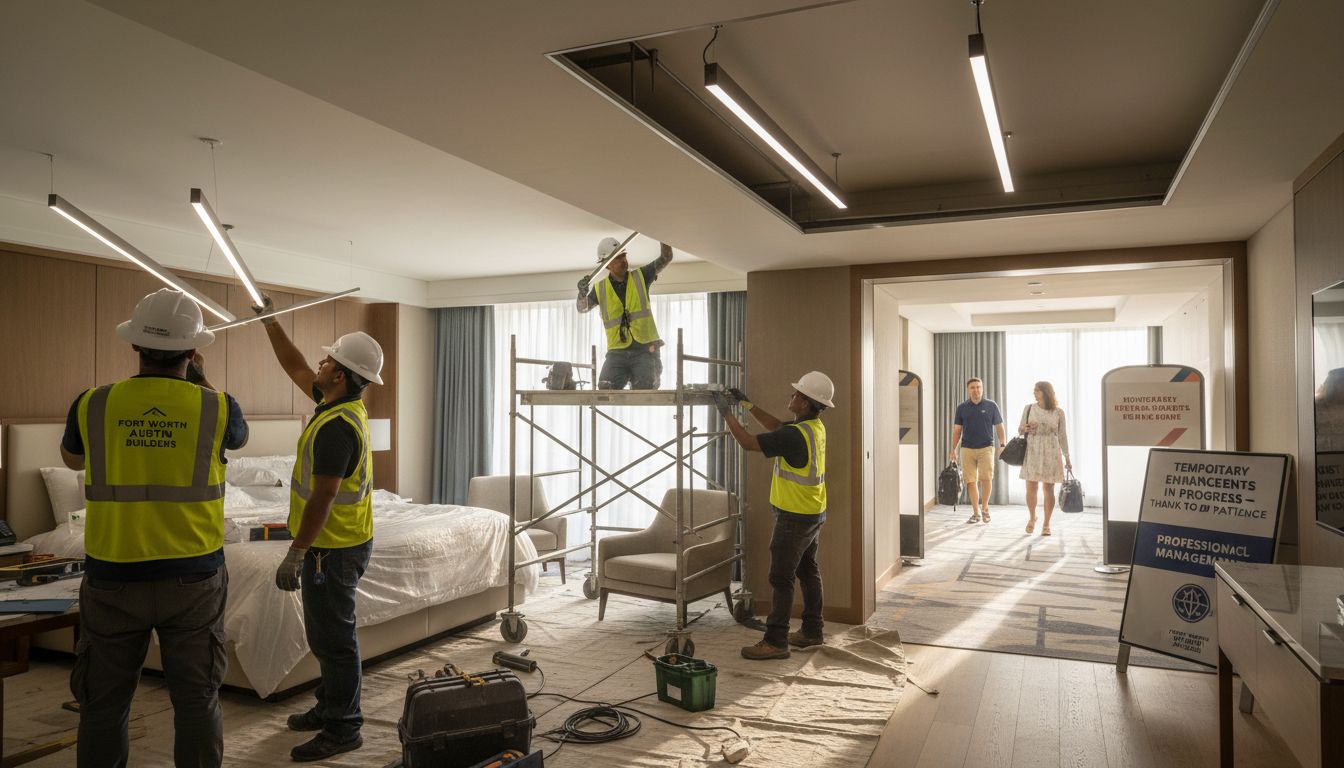
Occupied environments demand precision. Unlike new construction, hospitality renovations and room turns must proceed without interrupting guest stays, events, or daily operations. A miscalculation in scheduling or phasing can result in guest complaints, lost bookings, and significant revenue loss. This reality requires construction partners with proven experience managing occupied-environment work and the discipline to maintain operational continuity.
Timelines are unforgiving. Hospitality properties operate on thin profit margins, and every day of construction disruption represents lost revenue. A delayed room refresh can mean missed bookings during peak travel seasons. A slow-moving lobby renovation can harm guest perception and reduce walk-in traffic. Construction partners must demonstrate reliability, predictable scheduling, and the ability to execute fast, professional room turns without sacrificing quality.
System integration is critical. Modern hospitality properties rely on sophisticated HVAC systems, energy-efficient lighting, advanced plumbing, guest-facing technology, and safety infrastructure. These systems must work seamlessly together, and they must meet strict hospitality-industry standards. Poor integration leads to guest dissatisfaction, maintenance headaches, and operational inefficiency.
Capital planning requires foresight. Before construction begins, property managers need honest assessments of what needs to be done, how much it will cost, and how to sequence work for maximum return. This is where capital needs assessments, property condition evaluations, and strategic phasing become essential.
Design-Build: The Hospitality Construction Advantage
Design-build delivery combines architecture, engineering, and construction into a single, unified process managed by one accountable team. For hospitality projects, this approach offers distinct advantages.
Single point of accountability. Instead of managing separate architects, engineers, and contractors—with competing timelines and cost priorities—you work with one partner responsible for the entire project outcome. This eliminates finger-pointing, reduces coordination delays, and ensures that design decisions account for construction feasibility and cost from day one.
Faster delivery. Design-build allows construction to begin while design is still underway. Overlapping design and construction phases compress overall project timelines, which directly translates to reduced operational disruption and faster return to full revenue-generating capacity.
Cost predictability. With design-build, costs are locked in early, eliminating change-order surprises that derail budgets. Hospitality operators can make informed financial decisions and plan capital allocations with confidence.
Occupied-environment expertise. Design-build firms specializing in hospitality understand how to sequence work, minimize guest-facing disruption, and maintain facility operations during construction. They’ve navigated the logistical challenges—temporary walls, noise management, guest communication, staff coordination—that hospitality projects require.
What to Look For in a Hospitality Construction Partner
Not all construction firms are equipped to handle hospitality work. When evaluating a partner, prioritize these capabilities:
Direct hospitality experience. Ask for case studies and references from similar properties—senior living facilities, hotel upgrades, multi-family complexes with high occupancy rates, or commercial properties requiring active-environment work. A firm that has executed successful occupied-environment projects has the operational discipline you need.
Third-party assessment capabilities. Before construction begins, you need objective analysis. A qualified partner should offer property condition assessments and capital needs assessments to prioritize work, forecast costs, and identify quick wins that drive immediate ROI.
Transparency and communication. Hospitality operations move fast. You need a construction partner who provides clear, timely updates, acknowledges issues openly, and solves problems without creating surprises. Military discipline and proven teamwork often indicate this level of accountability.
Certified professionals. Your construction team should include licensed professionals with industry-recognized certifications. This demonstrates expertise, insurance coverage, and commitment to professional standards.
Commitment to quality and timeliness. Look for firms that emphasize “construction done right the first time” and back this claim with guarantees about delivery dates and budget adherence.
Fort Worth: A Regional Hospitality Hub
Fort Worth is emerging as a major hospitality destination. The Historic Stockyards transformation, the Fort Worth Convention Center expansion, and ongoing downtown revitalization all signal robust demand for accommodations and experiences.
For property owners in Fort Worth, this means opportunity—and urgency. Guests expect modern amenities, efficient operations, and flawless execution. Construction projects that enhance guest experience or improve operational efficiency can provide significant competitive advantage.
A local construction partner familiar with Fort Worth’s building environment, regulatory landscape, and hospitality market dynamics offers real value. They understand the region’s unique challenges—from weather-related delays to local contractor networks—and can navigate them effectively.
Austin’s Emerging Hospitality Frontier
Austin’s hospitality market is expanding rapidly. A large-scale destination resort under development promises to set new standards for hospitality design and amenities, signaling sustained investment in the market.
For operators considering Austin expansion or renovation projects, this growth presents both opportunity and competition. Your property must differentiate through exceptional design, efficient operations, and guest experience. A design-build partner with proven Austin experience understands the market, has established local relationships, and can execute projects that meet Austin’s high expectations.
Getting Started: From Assessment to Execution
The path to successful hospitality construction follows a clear process:
1. Assessment. Conduct a comprehensive property evaluation. Identify existing conditions, code compliance gaps, capital needs, and ROI priorities.
2. Planning. Work with your construction partner to develop a phased approach that balances operational continuity with project goals. Define scope, budget, and timeline clearly.
3. Design-build development. Proceed with collaborative design and construction planning, with cost and schedule locked in early.
4. Execution. Execute with precision, maintaining transparent communication and managing the occupied environment with military-grade discipline.
5. Delivery. Complete the project on time and budget, with all systems integrated, tested, and ready to deliver the guest experience you envisioned.
This structured approach reduces risk, accelerates timelines, and ensures that every dollar spent delivers measurable impact on guest satisfaction and property performance.
Why Veteran Expertise Matters
Veteran-owned construction firms bring distinct advantages to hospitality work. Military discipline, proven teamwork, integrity-driven operations, and commitment to mission completion translate directly into reliable construction execution.
Hospitality projects don’t tolerate excuses. Guests don’t reschedule. Bookings don’t wait. A construction partner with military discipline—someone trained to plan meticulously, adapt to changing conditions, and complete the mission on schedule—brings a mindset that hospitality owners deeply value.
The ROI of Strategic Construction
Investing in the right construction partner isn’t a cost—it’s a capital decision with clear returns.
A well-executed room renovation can increase nightly rates and occupancy percentages. An efficient lobby refresh restores guest confidence and boosts walk-in traffic. A strategic HVAC or energy system upgrade reduces operating costs while improving guest comfort. Each of these improvements compounds, building competitive advantage and strengthening long-term property value.
The cost of poor construction execution is exponentially higher: guest complaints, operational downtime, costly corrections, revenue loss, and damaged market reputation.
Your Next Step
Hospitality construction success depends on choosing a partner who understands the unique demands of your industry, has proven expertise in occupied-environment work, and brings the accountability and transparency you need.
Whether your project is a Fort Worth room turn, an Austin destination resort, or a capital improvement initiative at a multi-family or senior living property, partnering with a construction firm that specializes in hospitality work—and combines design-build expertise with direct industry experience—ensures that your project enhances guest experience, protects operational continuity, and delivers measurable financial returns.
The hospitality boom across Texas is real, and competition is intensifying. Your construction partner should help you capitalize on this opportunity, not create obstacles to it.
0 Comments