
I need to retrieve the information from the previous workflow steps to generate your blog post. Let me gather all the necessary details.
Capital Improvements That Pay Off: Strategic Renovation Strategies for Fort Worth Hospitality and Multifamily Properties
When property values depend on occupancy rates and guest satisfaction, cutting corners on maintenance isn’t an option—it’s a revenue drain. For hospitality managers and multifamily operators in Fort Worth, Texas, every renovation decision either strengthens your competitive position or leaves you vulnerable to newer, upgraded properties down the street.
The challenge is real: construction costs are climbing, new supply remains limited, and your aging assets can’t compete with Class A developments without strategic investment. But full ground-up rebuilds aren’t realistic. What works is targeted capital improvements—room turns, energy-efficient upgrades, and smart repositioning—executed by construction partners who understand occupied environments.
This guide walks you through proven renovation strategies that maximize your return on investment (ROI) while keeping your property operational.
Why Capital Improvements Matter More Than Ever
Capital improvements aren’t just maintenance. They’re strategic investments that directly impact your net operating income (NOI) and property value.
In Fort Worth and across the broader Texas market, property managers report that renovated units command 8–15% higher rents compared to unrenovated stock in the same community. For multifamily properties with 100+ units, that translates to significant annual gains. Hospitality properties see even faster payback: refreshed guest rooms increase occupancy rates and allow nightly rate premiums that offset renovation costs in months, not years.
The real barrier isn’t cost—it’s execution. Renovations in occupied environments require:
- Minimal operational disruption so tenants stay and guests return
- Fast unit turns to get revenue-generating spaces back online quickly
- Quality execution that lasts, avoiding costly rework
- Transparent budgeting so surprises don’t derail your investment timeline
Room Turns: The Foundation of Property Competitiveness
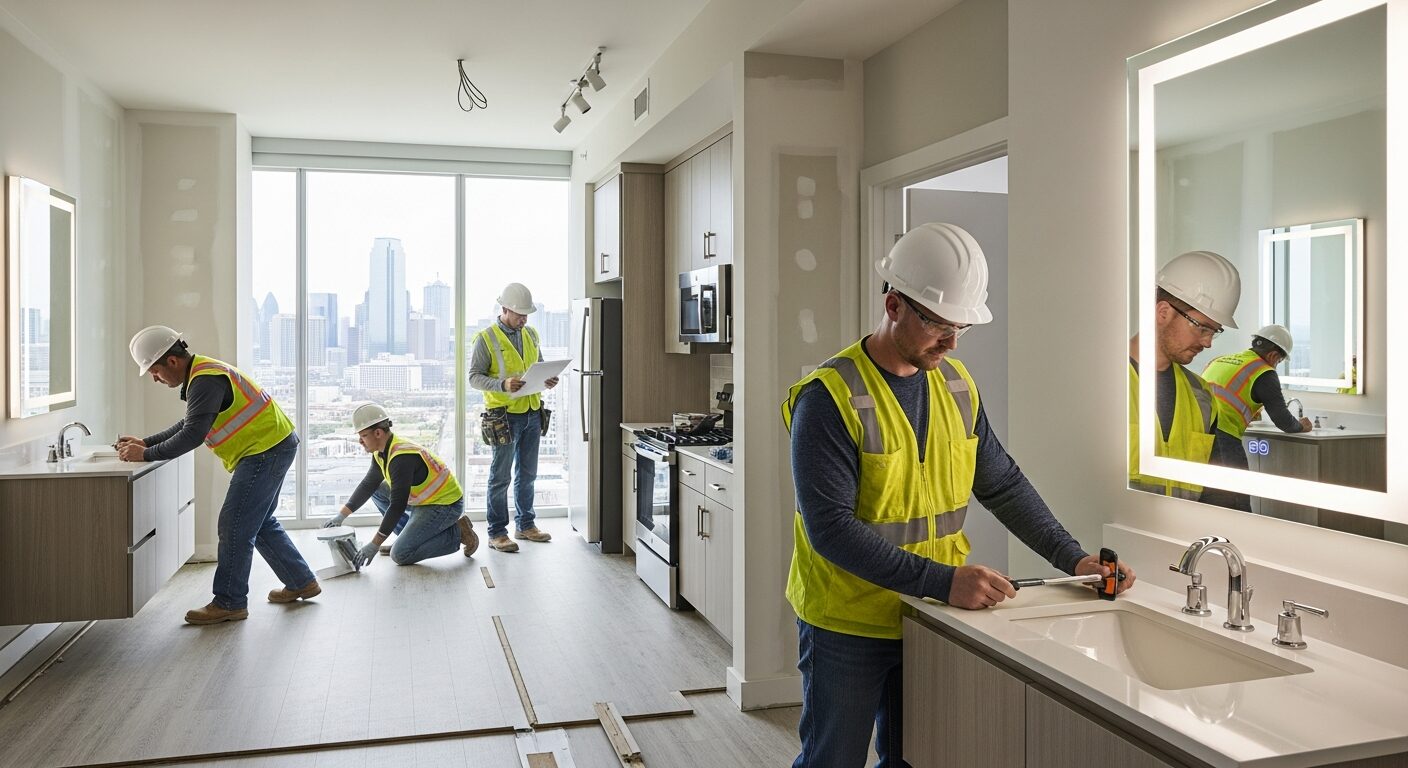
A room turn—refreshing a single unit or guest room—is the most targeted capital improvement you can make. When a tenant leaves or a guest checks out, that window of opportunity is your chance to upgrade, modernize, and increase rent.
Why room turns drive ROI:
Multifamily operators who execute strategic room turns report:
- Average rent increases of 5–12% on refreshed units
- Faster lease-up cycles (3–5 days faster than unrenovated units)
- Reduced vacancy loss due to higher market competitiveness
- Lower tenant turnover when apartments are modernized
Hospitality properties benefit similarly:
- Guests perceive cleaner, updated rooms as premium experiences
- Premium pricing—often 15–25% higher—becomes defensible
- Return visit rates increase when guest experience improves
- Reputation scores improve, boosting online booking conversion
The key is speed. A professional room turn team can complete a full apartment refresh—flooring, paint, fixtures, appliances—in 5–10 days, keeping your revenue clock ticking. Hospitality room turns happen even faster, sometimes in 48–72 hours between bookings.
Energy-Efficient Upgrades: Lower Costs, Higher Value
Capital improvements that reduce utility consumption are a rare win-win: they shrink operating expenses while making your property more attractive to environmentally conscious tenants and guests.
Common energy upgrades include:
- HVAC system replacements with high-efficiency units (20–30% energy reduction)
- LED lighting throughout common areas and units (40–50% lower electricity costs)
- Water-saving fixtures (low-flow toilets, showerheads) that reduce waste without compromising performance
- Insulation improvements in roofs and walls (especially valuable in Fort Worth’s hot summers)
- Smart thermostats that let tenants (or managers) optimize heating and cooling
In multifamily settings, energy upgrades often qualify for utility rebates or green financing programs, reducing your out-of-pocket cost. For hospitality properties, lower utility bills directly increase profit margins without raising guest fees.
Common-Area Repositioning: The Impression That Sticks
Tenants and guests judge a property the moment they arrive. Lobby renovations, exterior refreshes, and amenity upgrades send a clear signal: “This place invests in itself.”
High-impact common-area improvements include:
- Lobby and entrance upgrades (flooring, paint, lighting, signage)
- Parking area restoration and improved lighting
- Landscaping and exterior painting that boost curb appeal
- Fitness center or business center modernization
- Pool and outdoor amenity refreshes
These improvements don’t generate direct rent increases like unit refreshes, but they:
- Reduce vacancy rates by improving first impressions
- Support premium positioning and justify higher rents overall
- Reduce turnover costs (advertising, showing, leasing commissions)
- Lower tenant complaints tied to property maintenance
Phased Capital Plans: Spreading Investment Over Time
You don’t need to renovate everything at once. Strategic phasing lets you:
- Spread capital expenditures across multiple fiscal years
- Test upgrades on a small scale before company-wide rollouts
- Maintain cash flow while funding improvements through increased revenue
- Prioritize high-impact projects first (room turns, exterior) before cosmetic work
A typical phased plan might look like:
Year 1: Complete 20–30% of unit refreshes, focusing on high-traffic or turnover-prone areas. Update common lobby and entrance.
Year 2: Finish remaining unit refreshes. Install energy-efficient HVAC and LED lighting company-wide.
Year 3: Complete exterior work, landscaping, and parking improvements.
This approach spreads financial strain while building momentum. As fresh units come online, increased rental income funds the next phase.
Working With Experienced Construction Partners
Successful capital improvements depend on finding a construction firm that understands the unique demands of occupied-environment work. Your partner should:
- Have proven experience in multifamily and hospitality renovation—not just general construction
- Demonstrate speed without sacrificing quality—your revenue depends on fast completions
- Communicate transparently about budgets and timelines—surprises cost money and tenant relationships
- Understand how to coordinate with your operations team so guests and residents aren’t disrupted
- Provide certified, professional crews who respect occupied spaces and tenant privacy
In Fort Worth, construction management firms with military-discipline approaches and decades of combined expertise bring both accountability and craftsmanship to complex renovation work. Firms led by veterans understand the importance of planning, precision, and teamwork—qualities that translate directly to on-time, on-budget capital improvements.
Assessing Your Property’s Capital Needs
Before budgeting for renovations, conduct a Property Condition Assessment (PCA) or Capital Needs Assessment (CNA) to identify your top priorities. These professional evaluations:
- Identify immediate safety or code concerns
- Prioritize cosmetic improvements by ROI impact
- Estimate costs and expected revenue gains
- Help you secure financing based on objective data
- Provide lenders with confidence in your improvement plan
For property investors and managers in Fort Worth, third-party assessments are especially valuable because they’re independent and defensible—whether you’re refinancing, selling, or pitching capital plans to ownership.
The Bottom Line: Capital Improvements Protect Your Competitive Edge
In a tight real estate market with high construction costs and limited new supply, capital improvements aren’t optional. They’re how you defend your NOI, compete for tenants and guests, and position your property for long-term value growth.
The firms that execute these improvements fastest, most transparently, and with the highest quality gain the competitive advantage. Your property’s success depends on partnering with a construction team that understands occupied environments, respects your timelines, and delivers results that tenants and guests immediately recognize.
Whether you’re planning your first room turn or a company-wide capital program, the time to invest in your property’s future is now.
0 Comments