
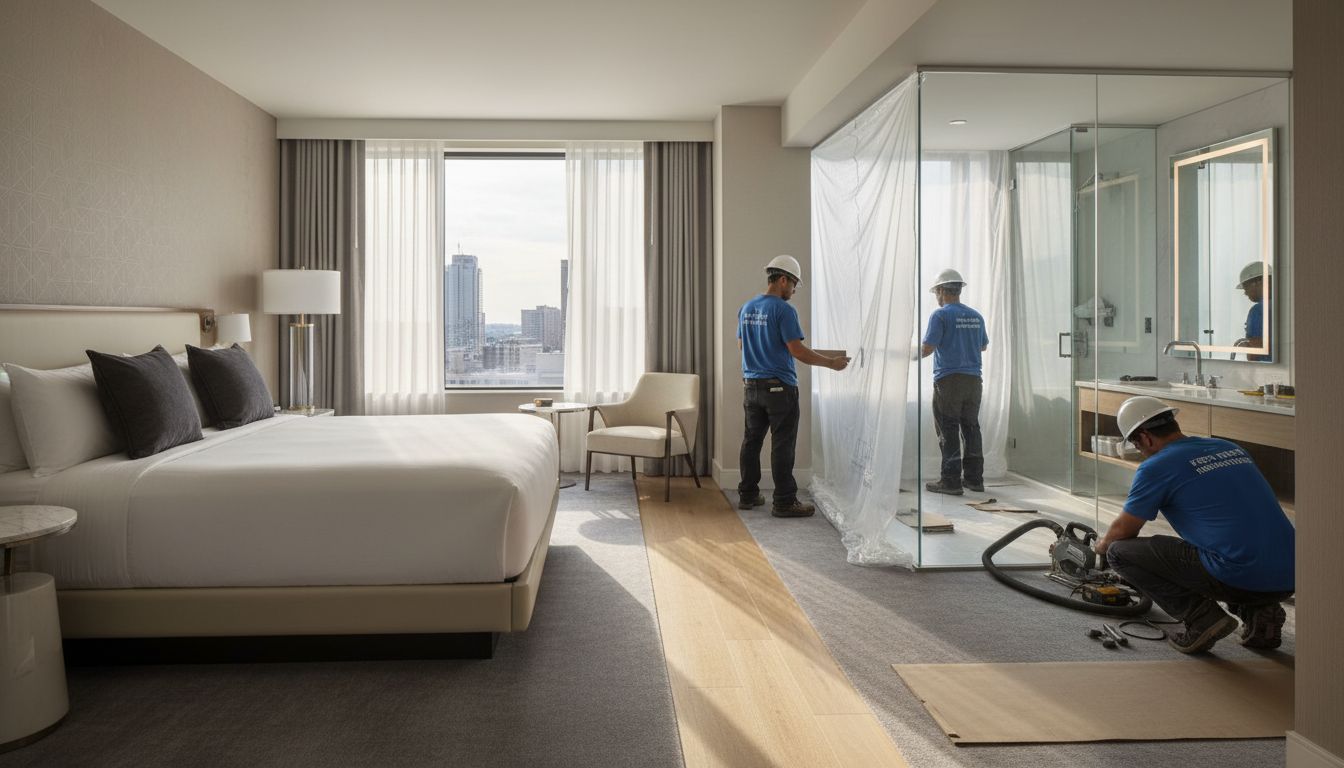
Hotel Renovations in Fort Worth: How to Stay Open During Construction
DFW hotels are in the middle of a multimillion-dollar renovation boom as property owners race to prepare for 2027’s packed events calendar. But here’s the challenge: most of these properties can’t afford to close their doors while construction happens. Guest rooms need refreshes, lobbies need upgrades, mechanical systems need replacement—all while keeping occupied spaces fully operational.
This pressure has created an urgent need for construction partners who understand how to execute complex renovations without disrupting guest experiences or revenue streams. If you own or manage a hotel in Fort Worth or the surrounding Dallas-Fort Worth area, the stakes are especially high right now.
Why Hotel Renovations Are Critical Right Now
The Dallas–Fort Worth construction market is exploding with opportunity. Recent permitting data shows the region continues to approve massive volumes of commercial and hospitality projects, with particularly strong demand for senior living, mixed-use developments, and Class A properties. But the hotel sector isn’t just catching up on deferred maintenance—they’re making strategic upgrades to capture higher rates and attract convention business.
The timing is clear: 2027 brings a strong events and convention calendar to the DFW region. Hotels that refresh their guest rooms, modernize their lobbies, and upgrade their back-of-house systems will command premium rates and higher occupancy. Those that don’t risk losing market share to competitors who invested now.
The challenge isn’t deciding whether to renovate. The challenge is figuring out how to renovate while keeping guests happy and revenue flowing.
The Occupied-Space Construction Problem
Most hotels operate at or near capacity during peak seasons. A traditional construction project that shuts down sections of a building, generates noise and dust, or disrupts parking and access isn’t an option. You need contractors who specialize in phased construction in occupied environments—teams that understand hotel operations, respect guest experiences, and can execute precise scheduling.
This is where many general contractors fall short. They’re trained to close off job sites, move at full speed, and manage chaos. Hotels need the opposite: surgical precision, transparent communication, and the ability to work within strict time windows.
What Occupied-Space Hotel Construction Requires
Working inside an operating hotel demands more than technical skill. Your construction partner needs to:
- Schedule work during guest transitions: Fast room turns between guests, overnight mechanical work, and early-morning deliveries require military-level discipline and planning
- Minimize disruption: Sound barriers, dust control, and access management keep guests and staff comfortable
- Maintain quality standards: Construction quality must be flawless because guests see and critique every detail
- Communicate transparently: Clear daily updates and escalation paths prevent surprises and guest complaints
- Meet aggressive timelines: Hotel owners need quick room turns to maximize occupancy and revenue
Most contractors excel at one or two of these. The best construction partners excel at all of them—and they bring a foundation of discipline and accountability that comes from understanding complex, high-stakes operations.
Room Turns, Mechanical Systems, and Strategic Upgrades
A typical hotel renovation during 2027 preparation involves several parallel workstreams:
Guest Room Refreshes and Unit Turns: New flooring, updated furnishings, fresh paint, and bathroom upgrades create the first impression guests remember. Fast room turns—sometimes 24 to 48 hours per room—demand coordinated crews, pre-staged materials, and zero rework.
Lobby and Amenity Upgrades: Common areas set the tone for the entire guest experience. Refreshing lobbies, updating elevators, modernizing corridors, and upgrading meeting spaces often happen while guests move through those same areas daily.
Back-of-House and Mechanical Systems: HVAC replacements, plumbing upgrades, electrical system modernization, and roofing work are critical to long-term reliability and energy efficiency. These projects often require extending work into evenings and weekends to keep critical building systems operational.
Energy-Efficient Upgrades: DFW property owners increasingly prioritize energy-efficiency retrofits—HVAC replacements, insulation improvements, and smart building systems—to reduce operating expenses and future-proof their properties against rising utility costs.
Each of these requires different expertise, strict phasing, and coordination. A single mistake—a delayed room turn, a mechanical failure, a missed deadline—echoes through the entire property and directly impacts revenue.
What Makes the Difference: Assessment, Planning, Execution, and Delivery
Hotels preparing for 2027 aren’t choosing contractors based on price anymore. They’re choosing based on track record, communication, and proof of reliability.
The best construction partners follow a proven four-step process:
1. Assessment: A detailed property condition assessment and capital needs analysis identify exactly what work is required, in what priority, and what the realistic timeline and budget should be. No surprises later.
2. Planning: Clear, phased construction schedules are created in collaboration with hotel management. Mechanical systems are mapped out. Room-turn sequences are coordinated. Contingencies are built in. Guest and staff needs are prioritized.
3. Execution: Disciplined crews execute the work with precision, transparency, and accountability. Daily communication keeps everyone aligned. Quality checks happen in real time, not at the end when rework costs time and money.
4. Delivery: Completed work is inspected thoroughly, punch-lists are cleared, and handover happens on schedule. The property is ready to operate at peak performance.
This structured approach sounds straightforward, but it requires construction leaders with the discipline to follow it, the expertise to troubleshoot when complexity arises, and the integrity to communicate clearly when challenges emerge.
The Veteran Advantage in Construction Leadership
DFW contractors with military backgrounds are gaining recognition for bringing something specific to complex renovation work: disciplined project management, safety culture, and accountability systems that translate directly to occupied-space construction success.
Military training instills the ability to plan meticulously, communicate clearly, execute under pressure, and adapt when conditions change. These skills are exactly what hotel renovations demand.
Veteran-led construction firms bring trusted leadership to high-stakes projects. When a hotel owner says “I need to stay open during construction,” a veteran-owned contractor who has managed complex operations and coordinated teams under pressure brings institutional credibility that reduces risk.
Why Third-Party Assessments Matter Before You Start
Before committing to a renovation schedule—especially with 2027’s deadline pressure—smart hotel owners commission independent property condition assessments and capital needs analyses. This protects you from:
- Underestimated project costs: Deferred maintenance often hides deeper infrastructure problems. An independent assessment surfaces these before budget surprises hit
- Unrealistic timelines: A thorough assessment identifies phasing constraints and dependencies that affect scheduling
- Contractor bid disputes: When scope is clearly documented by a third party, competitive bids are more reliable and defensible
- Financing challenges: Lenders and equity partners want to see thorough due diligence before funding renovation programs
This step adds modest upfront cost but prevents exponentially larger problems mid-project when guest rooms are offline and revenue is at risk.
Fort Worth and DFW Hotels: Your Construction Partner Is Local
If your hotel operates in Fort Worth, the surrounding suburbs, or anywhere across the Dallas–Fort Worth metroplex, you need a construction partner who understands the regional market, knows the local building code and permitting process, and has proven experience managing renovations in occupied hospitality spaces.
Local matters because:
- Permitting and inspections: A local contractor knows the city’s requirements, has established relationships with inspectors, and can navigate approvals faster
- Material sourcing: They have supplier relationships that ensure quality materials arrive on schedule
- Crew familiarity: Local teams understand the DFW work environment, labor conditions, and operational norms
- Emergency response: When something unexpected happens, you need someone who can get to your property immediately, not hours away
The Dallas-Fort Worth region is experiencing unprecedented renovation activity. Senior living communities are fast-tracking capital improvements to meet surging demand. Multifamily investors are pursuing aggressive value-add strategies with heavy renovation budgets. Commercial property owners are pursuing adaptive reuse and tenant-focused build-outs. And hotels are preparing for 2027 with multimillion-dollar upgrade programs.
That activity means experienced local contractors are in high demand—but it also means you have access to teams that have proven themselves in complex, fast-moving projects across the region.
What to Look for in a Hotel Renovation Partner
When vetting construction firms for your hotel renovation, ask for:
- Proof of occupied-space experience: References from other hospitality properties where construction happened while guests occupied the building
- Track record of fast room turns: Can they document 24-to-48-hour room refreshes? Do they have the systems and crews to execute at scale?
- Clear communication processes: How do they keep you informed daily? What’s their escalation path for issues?
- Project management discipline: Do they follow a structured assessment-planning-execution-delivery model? Can they show you how they control timelines and budgets?
- Transparent pricing: Are bids itemized and defensible? Do they explain scope clearly, or do they hide assumptions?
- Independent assessments: Are they comfortable with third-party inspections and audits, or do they resist oversight?
- Veteran leadership credentials: If leadership brings military background and experience, what specific disciplines do they emphasize?
The hotel renovation market in 2027 will separate winners from losers based on who invested now and who didn’t. But it will also separate contractors
0 Comments